Sleep...the one quest for all parents with young children. It is also, unfortunately, the one topic that has very few "right" answers. The idea behind this blog will be more informational with some general advice. I have to admit, the advice here is not something that is all evidence based. In fact, there are probably more books on this topic than any other parenting topic. I tell many of my families that this is the one area where you need to find what works best for you and your child/children. With that prologue, here we go...
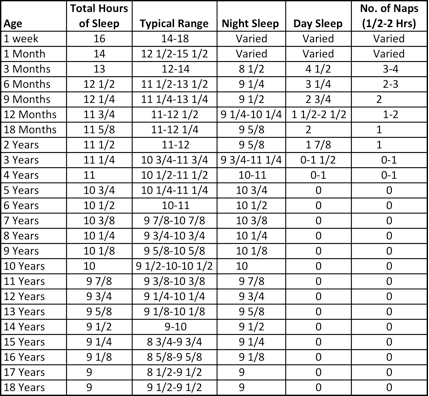
The one thing we all want to know is what is normal. There are multiple resources out there for normal ranges, but I like this one(below) the best because it breaks it down. Remember, there will be a range here and that each child is an individual, but this does give you a general reference. The key here is that the average total number of hours decreases with increasing age. The transitions are often gradual and may even be intermittent.
In general, adults will have 90-100 minute sleep cycles, resulting in 4-5 cycles per night. The sleep cycle in infants, however; is typically closer to 50 minutes. The fact that children and infants have twice as many stages of light sleep (part of the sleep cycle) explains why they wake more often during the night.
What is normal for waking up at night?
There was a study done in 2001 that videoed 80 infants in their own cribs at 3,6,9, and 12 months of age. They found that infants typically awaken 2-4 times per night at each of these stages. Night-time awakening persists through infancy. However, there is an increase in self-soothing by 6 months of age(62% self-soothe). Nevertheless, even in the 12-month-old group, 50% of infants typically required parental intervention to get back to sleep after waking.
Sleep Problems
Sleep problems occur in 20-30% of children. They can be divided into problems with falling asleep and problems with arousals during sleep. (There is a third category on excessive daytime sleepiness, but this could be a whole blog in itself). These problems can come and go over time, but they are frustrating and sometimes even scary to children and parents alike. I am going to break down some of the most common sleep problems and hopefully give some suggestions for what to do. Remember, not all of this is evidence based!
Problem 1: Trained Night Feeding:
This is usually described as a prolonged need for a nighttime
feeding. By 6-9 months of age, many infants no longer need a middle-of-the-night
feeding. Most infants, however; continue to awaken at least a few times a night. The problem most often occurs because of frequent small feeds during the
day with short intervals between feeds (which become expected at night). This entity is quite common in breast feeders
with frequent daytime feeds, but also occurs in bottle feeders, many of whom
have learned to fall asleep with a bottle in bed.
Suggestion: Decrease night feeds
gradually. This can be done by
decreasing the volume in the bottle or nursing time and making these feedings
brief and boring. For bottle-fed babies, parents should discontinue the bottle
in bed. At the same time, parents should
increase the daytime feeding intervals to > 4 hours, if possible. (This is less realistic for breastfeeding
infants, since they typically feed more frequently.) With time, the nighttime feedings will be so
brief and the baby gets accustomed to longer feeding intervals that the night
feedings will diminish.
Here is the tough one. This is when your loving baby continues to need help getting back to sleep after awakening in the middle of the night (after giving up the night-time feeding). In many cases, the problem begins with your baby being placed in bed after falling asleep. The problem is that your baby is not trained to fall asleep in her own bed. She is usually fearful upon awakening because she is in a new environment and needs you present to settle. Trained night waking may also occur for the first time in an older infant or toddler. It is particularly common at 9-12 months after an acute illness or change in environment. You wake during the night to comfort the your sick baby who then grows accustomed to this response. When the illness has resolved, she still wakes and expects/hopes for your nighttime presence.
I hope this is helpful information. For additional questions, please see your pediatrician or care provider. We are here to help!!
-Dr. M
Note: All comments are welcome on the blog, but please do not post medical questions. I am, unfortunately, unable to respond to personal medical questions through this website. Thank you for understanding!
A quick thank you to the Harriet Lane Clinic (at Johns Hopkins) for your resources for this blog. Thank you!
Problem 2: Trained Night Crying
Here is the tough one. This is when your loving baby continues to need help getting back to sleep after awakening in the middle of the night (after giving up the night-time feeding). In many cases, the problem begins with your baby being placed in bed after falling asleep. The problem is that your baby is not trained to fall asleep in her own bed. She is usually fearful upon awakening because she is in a new environment and needs you present to settle. Trained night waking may also occur for the first time in an older infant or toddler. It is particularly common at 9-12 months after an acute illness or change in environment. You wake during the night to comfort the your sick baby who then grows accustomed to this response. When the illness has resolved, she still wakes and expects/hopes for your nighttime presence.
Suggestion: First of all, I tell every family that this is something you, as a family, all have to be ready for. If you can't imagine letting your baby cry or if you mentally can't let your baby cry, then it is probably not the time to fix the problem. Once you are ALL ready, then go for it.
For a young infant with trained night waking, the goal is to put your baby to bed in her own crib while awake but drowsy. Your baby must learn how to fall asleep in the same environment that will surround her when she awakens during the night (alone and in her crib without a bottle). This will allow her to put herself back to sleep when she does awaken.
For a young infant with trained night waking, the goal is to put your baby to bed in her own crib while awake but drowsy. Your baby must learn how to fall asleep in the same environment that will surround her when she awakens during the night (alone and in her crib without a bottle). This will allow her to put herself back to sleep when she does awaken.
Training and Retraining an infant or
toddler who has developed a pattern of night crying can be VERY stressful for
families. There are a number of
suggested approaches; almost all require that the child be allowed to cry as
part of settling. One approach seen in many books (example: Dr. Ferber's Sleep BooK) involves
weaning the child away from needing parental presence slowly. This can be done as follows:
If
the baby awakens and cries:
·
Wait 3-5 minutes.
·
Go in during a lull in crying to check that the
infant is okay.
·
Do not talk to the infant or pick her up, but rather briefly
pat her at the side of the crib, then leave.
·
If she continues to cry, return 5-10 minutes later
for 1 minute.
·
Increase the time prior to intervening on successive
nights.
This approach of checking
the infant at increasing intervals appears easier for the infant and parent,
rather than ignoring the infant completely.
It helps the infant know that she has not been abandoned, and multiple
observations by the parent allow them to see that the infant is really okay.
For some of you who have children like my oldest, going into the room as suggested above may only cause worsening of the screaming. Sometimes, you may just have to let them cry without intervention. A video monitor is very helpful in these cases. Believe, I am not saying I did this perfectly or that we were the model family. However, once they learn to sleep on their own, you and your baby will be much happier. The earlier this is done the better. Try comparing your 6 month old crying to sleep versus your toddler screaming "mommy, daddy, I want you" . Which one sounds easier? :)
For some of you who have children like my oldest, going into the room as suggested above may only cause worsening of the screaming. Sometimes, you may just have to let them cry without intervention. A video monitor is very helpful in these cases. Believe, I am not saying I did this perfectly or that we were the model family. However, once they learn to sleep on their own, you and your baby will be much happier. The earlier this is done the better. Try comparing your 6 month old crying to sleep versus your toddler screaming "mommy, daddy, I want you" . Which one sounds easier? :)
One warning about prolonged co-sleeping....When infants are in the same room or co-sleep
with parents, it is much more common that parents will awaken to any type of
stirring by the infant, and intervene before the infant has the chance to
soothe herself.
Finally, it is great if you can use transitional objects such as a favorite blanket or small toy by 6 months of age. This allows the child to have control and can readily have the object whenever desired. Good luck! (this is one of my least favorite parts of being a parent with a baby this age)
Finally, it is great if you can use transitional objects such as a favorite blanket or small toy by 6 months of age. This allows the child to have control and can readily have the object whenever desired. Good luck! (this is one of my least favorite parts of being a parent with a baby this age)
Problem 3: Developmental (Fearful) Night Crying
This is described as unexplained new onset of night
crying. This is different than nightmares and night terrors (see below) It is usually seen late
in first year, but may occur in older children. The exact etiology is not clear. Some possibilities include the onset of
visual memory and separation anxiety, or the onset of nightmares in
preschoolers or a child with a low sensory threshold. Around 3 years of age, a child may develop a
fear of her environment (i.e. fear of dogs, monsters, darkness, etc).
Suggestion: For the younger child, it is okay to
check on the child. They can talk to her
in her crib, hold her at crib side, or introduce a transitional object. For the older child, reassure the child about
her fears. Discontinue scary TV
watching, use a nightlight, reinforce transition object, and leave the doors
open. Play-acting out fears may also
help.
Problem 4: Prolonged Bedtime Routine
This is another case of easier said than done. Believe it or not, a bedtime routine that takes longer than 30 minutes is considered
prolonged. Prolonged bedtime routines occur most frequently in
preschoolers. It is generally a problem
of falling asleep, but may be exacerbated by parental behavior. During the second year of life, toddlers
often have problems with separation and object permanence, and frequently try
to avoid the fear of loss by holding on to important ties. The toddler tries to stay awake, seeking to
maintain contact with the waking world.
For older children, consider we are usually the ones enabling the delayed bedtime. There
are many reasons we may be unintentionally contribute to such
behavior: we enjoy spending time
with the child at bedtime or we sometimes feel guilty after being away from the child all day. School age children may resist
going to sleep or have trouble because of worries or anxiety.
Suggestions: Transitional objects can be introduced after 6 months and
bedtime routines may be initiated after 1 year of age. The usual bedtime routines are < 30
minutes, but in some cases, tucking in, prayers, stories, use of transitional
objects and multiple visits by both parents can extend the routine to over an
hour. This is usually an exercise in
discipline. The goal is to ignore the protests while being consistent
and firm in bedtime routine. Parents can
wean the child who protests their leaving by sitting silently in the room as
the child falls asleep and moving 1 foot closer to the door each night until he
or she is out of the room. For school
aged children, careful assessment of anxieties may be helpful.
Problem 5: Night Terrors
These are intense arousals in which a toddler or young child
may awaken with a terrifying “blood-curdling” scream, and be found with a look
of fear or panic, with eyes wide open, heart racing, and sweating
profusely. In extreme cases, a child may
leap out of bed and appear to be “running away from something,” with the risk
of associated accidental injury. The
child is generally not responsive to questions. Night terrors are disordered arousals from Stage III or IV
that occur after 60-90 minutes of sleep. From the parents’ perspective,
this is one of the most upsetting sleep problems. Night terrors occur in 3% of children,
usually from 18 months to 6 years of age.
They are not associated with mental health issues at this age but may
occur after a stressful event or a fatiguing activity. There is often a family history of sleep
terrors, sleepwalking or talking during sleep.
Suggestions: You should NOT forcibly awaken your child. The goal here is to guard against injury and
allow the event to run its natural course (typically 10 minutes). The episode will abruptly end with the child
falling back to sleep and not recalling the episode upon awakening. These events, although terrifying, are benign in nature and they tend to resolve around age 6-8 years. If a pattern develops, awakening the child 30
minutes before the expected episode (generally 1 hour into sleep) each night
for several nights may interrupt the pattern.
A 30-60 minute afternoon nap may also reduce stage IV sleep, thereby
decreasing episodes.
Problem 6: Nightmares
Nightmares, as opposed to night terrors, are dreams—scary
dreams that wake a child and leave her feeling frightened, anxious, and with a
profound sense of dread. Nightmares are extremely common. Children have been found to dream by 14 months of age, but nightmares
are most common between 3-6 years of age with easy arousal and vivid recall of
the content.
Suggestions:
Love on your child and give them comfort and support.
Comparison of night terrors and
nightmares:
Night Terrors
|
Nightmares
| |
Consolability
|
Poor
|
Good
|
| Do they remember the event? |
No
|
Yes
|
Interest in returning to sleep
|
High
|
Low
|
Problem 7: Sleepwalking and sleep talking
These consist of behavioral sequences which involve abruptly
sitting upright in bed, glassy-eyed and unresponsive, with unintelligible
speech, clumsy movements. They are NOT enactments of dreams.
These are disorders of arousal which occur in stage IV
sleep, generally 60-120 minutes into sleep. They commonly occur during
school-age and are often associated with wetting the bed(or themselves). About 15% of children sleepwalk at some time,
while 1-6% of children have 1-4 attacks per week, mostly between 4-12 years of
age. They may be triggered by excessive
fatigue, changes in routines, and daily stresses.
Suggestions: The child needs to be protected against self-injury. In some cases, alarms and door or window
locks may be needed.
I hope this is helpful information. For additional questions, please see your pediatrician or care provider. We are here to help!!
-Dr. M
Legal Disclaimer: This blog is designed to provide general information related to pediatric and adolescent care. The information presented on this blog should not be construed as formal medical advice, nor does accessing this site constitute formation of a doctor (or other healthcare provider)-patient relationship. The content is intended solely for informational and not for treatment purposes. Do not use this site if you believe you may have a medical emergency; call 911 or your doctor's office immediately.
A quick thank you to the Harriet Lane Clinic (at Johns Hopkins) for your resources for this blog. Thank you!

Dr M, This is awesome advice, even for myself as a pediatrician - parent :) My second just turned 2 months and we are already dreading the transition to the crib in her room since my son's transition was not easy - thank you for this reminder that everything will be OK! Tamorah Lewis
ReplyDeleteYou are right...sometimes it is great to have a reminder that everything will be ok. Like I said, this wasn't easy for me either. Sometimes it is hard to take the advice I give out!
Delete