
In response to many of your suggestions, I am going to be doing some summer related topics. I am going to start with a topic very dear to my heart - tanning and skin cancer. For those of you who do not already know, my father-in-law passed away from Melanoma in 2006. Therefore, it is very important for me to educate everyone about sun health. I hope this is helpful and informative..
In the upcoming year, there will be at least 62,190 new diagnoses of invasive melanoma(this includes children!) and more than 1 million cases of basal and squamous cell carcinoma. The UV radiation from the sun is responsible for at least 65% of melanoma cases and 80% of all skin cancers. The good news for our children is that limiting sun exposure during childhood and adolescence can reduce the life-time risk of developing non-melanoma skin cancers by as much as 78%. Unfortunately, despite the evidence that skin exposure in childhood contributes to cancers later in life, the estimated numbers of skin burns in this age group has not diminished over the past decade.
So , what can you do...
Schedule your day around the sun
- Avoid exposure to the sun during the hours of 10:00am and 4:00pm when the suns rays are most intense
- Be especially careful in the hour around noon (11am-1pm)
- Overcast days can give a false sense of security. (Over 70% of the sun's rays still get through the clouds).
Use Protective Clothing
- The protection of clothing depends primarily on the construction of the fabric (a tighter weave permits less UV radiation to reach the skin)
- Over 30% of the suns rays can also penetrate loosely woven fabrics(ex: a standard cotton t-shirt)
- The type of fiber from which the clothing is made is important - Natural cotton or LycraTM transmits less UV radiation than bleached cotton.
- Color is also important - darker colors transmit less UV radiation.
- Transmission of UV radiation increases as the fabric becomes more wet and stretched.
Teenagers AVOID TANNING BEDS!
- The National Institute of Environmental Health Sciences concluded that use of sunlamps and tanning beds cause skin cancer.
- The type and amount of radiation emitted from tanning beds appear to be similar to that of noontime summer sun, and in some cases, the amount is even higher than the sun would emit.
- Artificial UV radiation can substantially damage skin (ie: cause sun burn) and has been linked to eye melanoma.
Sun Screen: When to Apply

- Apply sunscreen approximately 20 minutes before being in the sun so that it can be absorbed by the skin and less likely to wash off with perspiration.
- Reapply sunscreen after swimming or strenuous exercise.
- Apply sunscreen often throughout the day if you are working or playing outdoors for a long period of time.
Sun Screen: How to Apply
- Make sure your sunscreen has not expired!!
- SHAKE WELL
- Use enough - use a handful (or more) to cover the entire body.
- Use on all sun exposed areas including the ears, back, shoulders, back of knees, and back of legs.
- APPLY THICKLY and THOROUGHLY.
Sun Screen: How to Buy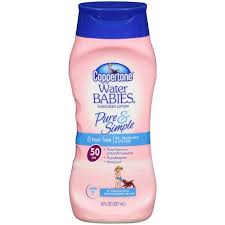
- Pick a broad-spectrum sunscreen that protects against UV-A and UV-B rays and has an SPF of at least 30.
- Read Product Labels. Look for a water-resistant brand if you will be sweating or swimming. Warning - even if it is water "proof" you still need to reapply OFTEN!
- Use a water-based sunscreen if your child has oily skin or is prone to acne
- Be aware that more expensive does not mean better
- There is no evidence that using an SPF > SPF 50 is any better than SPF 50 so don't buy into the hype of the higher SPF values.
Have your child's skin examined
It is important for you and your children to have a yearly skin exam by your doctor or a dermatologist. It may not be comfortable, but it can be life saving!
If your Teen(or you) wants to Tan
- For teenagers who are determined to have a suntan, guide them as to the limits of sun exposure without sunscreen.
- Try to keep sun exposure to small amounts early in the season until a tan builds up
- Start with 15 or 20 minutes of sun per day and increase by 5 minutes a day. Decrease daily exposure time if the skin becomes reddened.
- Because of the 2- to 4- hour delay before symptoms appear, don't expect symptoms to tell when it is time to get out of the sun!
Summary
- Use of various methods of protection (avoiding the sun, seeking shade, wearing protective clothing, and liberal use of sunscreen) is the best way to protect against skin cancer.
- Use sunscreen IN ADDITION to other protective measures
- Apply and reapply sunscreen correctly.
- Limit or minimize exposure to the sun during peak hours (10am-4pm). This is especially important during the 1 hour period closest to the noon hour (11am-1pm).
- Avoid sunlamps and tanning beds.
- Have your children's' moles evaluated by your doctor and dermatologist
- Have a great summer and be safe!!
Note: All comments are welcome on the blog, but please do not post medical questions. I am, unfortunately, unable to respond to personal medical questions through this website. Thank you for understanding!
Legal Disclaimer: This blog is designed to provide general information related to pediatric and adolescent care. The information presented on this blog should not be construed as formal medical advice, nor does accessing this site constitute formation of a doctor (or other healthcare provider)-patient relationship. The content is intended solely for informational and not for treatment purposes. Do not use this site if you believe you may have a medical emergency; call 911 or your doctor's office immediately.

At what age can you start to apply sunscreen to your child?
ReplyDeleteTechnically, you shouldn't apply sunscreen before 6 months of age.
ReplyDelete